
Bringing Home a Spring Puppy: The Essential Treat & Training Starter Guide

Bringing Home a Spring Puppy: The Essential Treat & Training Starter Guide

Back to blog

You've decided to start your puppy on raw. Great decision. The first year of a dog's life is when nutrition matters most — and raw feeding gives you the best possible foundation to build on.

What comes next is the practical bit. This guide covers everything you need to get started with confidence: what to feed, when, how much, how to handle the food safely, and what to do when things don't go perfectly to plan. Because occasionally they won't — and that's completely normal.

Before the First Meal: A Few Things Worth Knowing

Raw feeding is straightforward once you're in the rhythm of it. But a little preparation goes a long way.

Keep things simple at first. The instinct is often to offer variety immediately — but puppies' digestive systems are still developing, and introducing too many new proteins at once makes it hard to identify any intolerances. Start bland. Expand gradually.

Handle raw food like you'd handle any raw meat. Wash your hands after serving, clean bowls thoroughly after each meal, and defrost in a sealed container in the fridge — never at room temperature or in warm water.

Don't compare your puppy to the guidelines blindly. Feeding amounts are always a starting point, not a rule. Your puppy's breed, size, activity level, and rate of growth all affect how much they need. Watch their body condition and adjust accordingly.

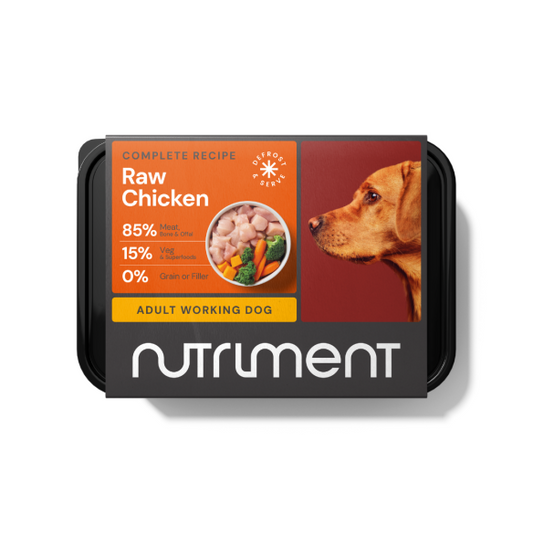
Tray of Nutriment Just Raw Chicken Weaning Paste for puppies, featuring chunks of chicken and a puppy image on label.

Stage 1: Weaning (3–6 Weeks)

If you're a breeder — or you've brought home a very young puppy — the starting point is Nutriment's Weaning Paste.

Made from a single ingredient — 100% human-grade British chicken, ground to a smooth paste with fine bone — it's designed to sit alongside the mother's milk rather than replace it. Offer a small amount after a milk feed, not before. Let them suckle first.

The fine bone content is easy on young teeth and digestive systems, and the simplicity of a single protein means there's nothing to react to. It's the ideal first introduction to solid food.

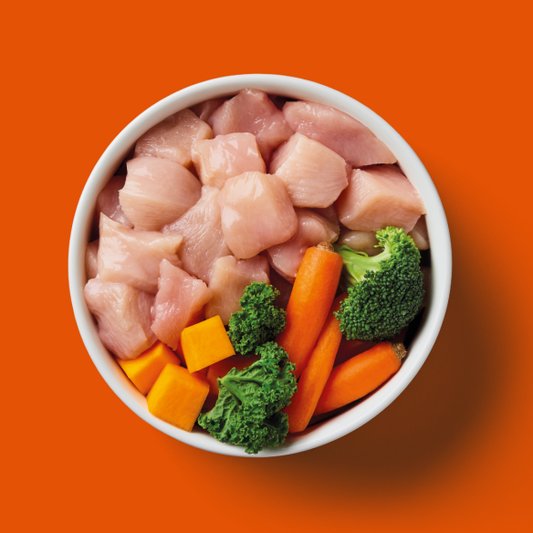
A bowl of raw diced chicken, broccoli, carrot slices, kale, and pumpkin on a blue background.

Stage 2: First Full Meals (6 Weeks–4 Months)

From six weeks onwards, puppies can move onto Nutriment's Puppy Formula for every meal.

The recipe is specifically formulated for growing bodies: British chicken with bone, beef heart, green tripe, kidney, liver, fresh carrots, butternut squash, broccoli, kale, salmon oil, coconut oil, sea kelp, bilberry powder, spirulina, sesame seeds, and wheat germ oil. It's more finely ground than adult recipes to support a puppy's developing digestive system, and the bone content is calibrated to support healthy skeletal development.

How much to feed: 5–6% of your puppy's current body weight per day, split across multiple meals.

How often: Three meals a day up to around six months, then gradually reduce to two as they grow.

Not sure where to start? The Nutriment 5kg Puppy Starter Pack is the easiest first order — enough to get going, with no guesswork about quantities.

A woman serves raw dog food into a bowl while a happy dog looks on eagerly in a kitchen.

Stage 3: Introducing Variety (4 Months Onwards)

At around four months, you can start introducing recipes from the wider Nutriment core range. This is the fun part — finding out what your puppy loves.

A few things to keep in mind:

  • Introduce one new protein at a time, with a few days between each new addition. This makes it easy to spot any sensitivities.
  • Don't rush it. There's no prize for getting through the whole range quickly. A puppy that's settled on two or three proteins they do well on is in a better position than one that's been bombarded with variety too fast.
  • Watch the stools. Firm, well-formed, and relatively odourless is what you're looking for. Loose stools after a new protein are often just a sign of adjustment — give it a few days before drawing conclusions.

How Much Should You Feed?

Raw feeding quantities are based on body weight, not the size of the bag.

A dog eats from a bowl; chart shows feeding guidelines by age and weight for dogs.

These are guidelines, not rules. A very active puppy may need more. A puppy that's gaining weight too quickly needs less. Use our raw feeding calculator as your starting point and adjust from there.

Smaller breeds are typically fully grown by around 12 months. Larger breeds may not reach full size until 18 months or beyond — so keep feeding puppy quantities until growth has genuinely plateaued.
When to Move to Adult Food

The transition to adult recipes isn't about age — it's about size. Move your puppy onto adult portions when they've reached approximately their full grown weight.

When you're ready, do it gradually. Mix increasing amounts of adult food into their usual puppy meal over the course of a week, reducing the puppy formula proportionally. Abrupt changes can cause digestive upset even in dogs that are otherwise settled on raw.

Safe Handling: The Non-Negotiables

Raw food is safe when it's handled properly. The basics:

  • Defrost in the fridge, in a sealed container. Never on the worktop or in warm water.
  • Use within 3–4 days of defrosting. Don't refreeze once thawed.
  • Clean bowls after every meal — don't leave raw food sitting in a bowl.
  • Wash hands and surfaces thoroughly after handling.
  • Keep raw food away from other food in the fridge.

That's genuinely all there is to it. The same hygiene practices you'd apply to raw chicken for your own dinner apply here.

Common Problems — and What to Do

Loose stools after switching Very common, especially in the first week. The gut is adjusting. Stick with a single, simple protein and give it a few days. If it persists beyond a week or is accompanied by other symptoms, speak to your vet.

Puppy refusing to eat Try defrosting slightly longer so the food is closer to room temperature — cold food straight from the fridge can put some puppies off. A very light warm (not cooked) in your hands or a brief sit at room temperature is usually enough.

Stools are too hard or chalky Often a sign of too much bone. Reduce the bone ratio by mixing in a lower-bone recipe, or try a different protein.

Intermittent loose stools when introducing new proteins Normal in many puppies. Introduce new proteins more slowly — a week per new addition rather than a few days — and revert temporarily to something they tolerate well if things get unsettled.

Supporting Your Puppy Beyond the Bowl

A complete raw diet covers your puppy's core nutritional needs — but some owners like to give their puppy's development an extra boost during the critical first year.

AniForte's Puppy Prime is a daily supplement powder developed specifically for growing dogs, combining 29 targeted nutrients across brain development, gut health, joints, and immunity. It sprinkles straight onto food, is grain and gluten free, and is suitable from 8 weeks. A straightforward addition for owners who want to cover every base.

For training, natural treats make a far better reward than anything processed. Nutriment's treats and bones range includes single-ingredient options that are easy to break up, low in additives, and something most puppies will work very hard for.

A Quick-Reference Summary

  • 3–6 weeks: Weaning Paste alongside mother's milk
  • 6 weeks–4 months: Puppy Formula, 3 meals a day, 5–6% of body weight
  • 4 months onwards: Introduce variety from the core range, one protein at a time
  • Approaching adult size: Begin reducing to 2–3% of body weight
  • Fully grown: Transition to adult recipes gradually over 7 days

Throughout: Simple hygiene, watch body condition, adjust portions as needed

Ready to get started? The Nutriment Puppy Starter Pack is the easiest first step — and our raw feeding calculator will work out exactly what your puppy needs from day one. 🐾