
A person in a green sweater rubs a black dachshund's belly as it lies on a blue dog bed.

Gut health

Raw-fed dogs show significantly higher levels of beneficial gut bacteria — and better digestion from the very first meals.

7,015 dogs studied by DogRisk at the University of Helsinki. Puppies fed raw during the first 6 months had significantly lower risk of chronic digestive problems in adult life.

A raw meat-based diet was shown to increase bacterial diversity in the gut, improve stool quality, and enhance production of short-chain fatty acids like butyrate — compounds directly linked to gut health and immune function.

Conversely, extruded kibble diets were associated with higher rates of chronic enteropathy in adult dogs. ¹

Profile view of a golden-brown dog with a focused expression against a dark background. The dog's smooth coat and alert eyes are prominently displayed.

Skin, coat & teeth

74% better skin. 88% improved digestion. 79% clearer eyes. Reported by 632 dog owners after switching to BARF.

4,771 dogs in a University of Helsinki dental calculus study. Raw-fed dogs had significantly lower odds of developing dental calculus; kibble-fed dogs showed markedly higher risk at every life stage.

Dogs fed a raw meat-based diet showed lower alkaline phosphatase levels, higher lymphocyte counts, and improved clinical health scores — particularly for dental and skin health — compared to kibble-fed dogs. A separate skin transcriptome study found that a raw meat-based diet may enhance innate immunity, reduce oxidative stress, and support skin barrier function. ²

A person in a green sweater holds a treat above a standing dachshund reaching up on its hind legs.

Allergies & early life

Puppies fed raw early in life have a significantly lower risk of developing skin allergies, inflammatory bowel disease, and ear problems as adults.

16,607 owner responses in the DogRisk food frequency questionnaire — the world's largest canine diet dataset. Consistent finding: non-processed meat-based diets in early life are protective.

Multiple independent studies using DogRisk data found that non-processed meat-based diets during weaning, puppyhood and adolescence were associated with lower rates of atopic dermatitis, inflammatory bowel disease, and otitis in adult dogs. Ultra-processed carbohydrate-based diets — dry kibble — increased risk across all three conditions.³

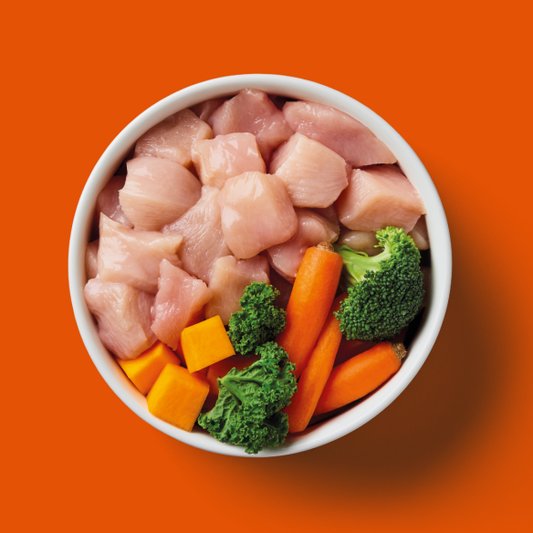
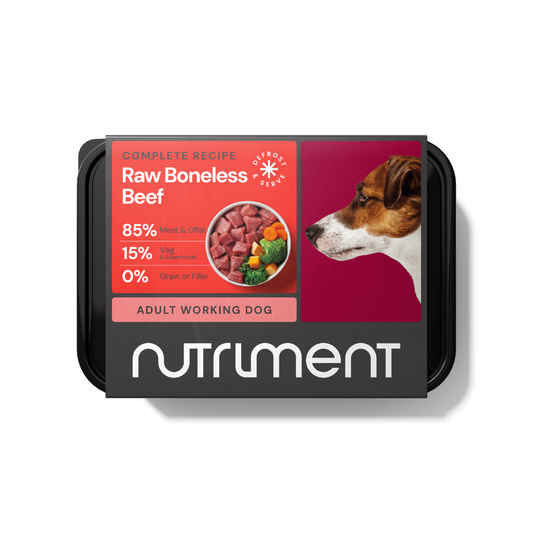
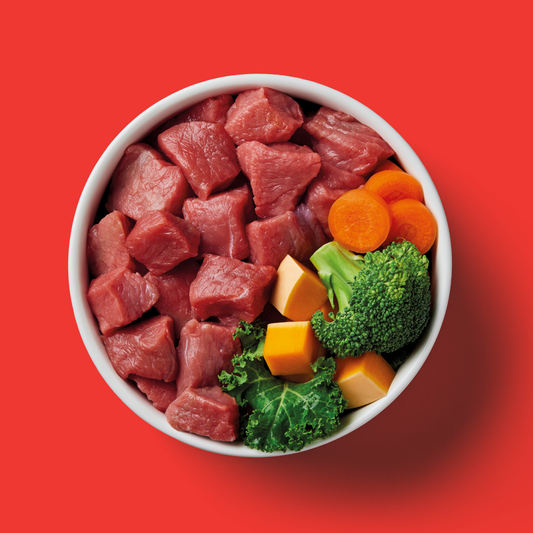
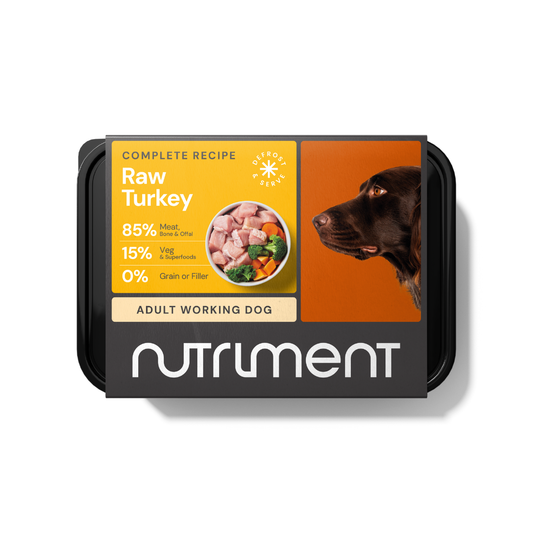
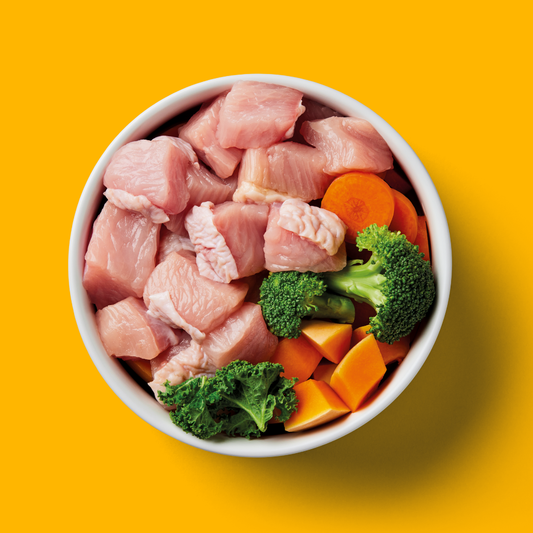
A bowl with Raw Turkey 1.4kg for dogs, broccoli, and carrots, labeled perfectly balanced and easy to digest.

Digestibility & bioavailability

Heat processing destroys enzymes, damages amino acids, and significantly reduces the nutritional value of what's in the bowl.

Up to 90% of thiamine (Vitamin B1) can be lost during dry food manufacturing. Thiamine deficiency was responsible for 5 out of 12 vitamin-related pet food recalls between 2009 and 2017.⁴

A dog sniffs a bowl of dry kibble being offered by a person on a wooden surface.

Cancer risk

Dry dog food contains acrylamide — a harmful chemical associated with cancer — at concentrations up to four times higher than average human daily intake. Raw food undergoes no high-heat processing and contains no acrylamide.⁵

References 1:

Sandri, M., Dal Monego, S., Conte, G., Sgorlon, S. & Stefanon, B. (2017). Raw meat based diet influences faecal microbiome and end products of fermentation in healthy dogs. BMC Veterinary Research, 13(1). https://bmcvetres.biomedcentral.com/articles/10.1186/s12917-017-0981-z

Vuori, K.A., Hemida, M., Moore, R., Salin, S., Rosendahl, S., Anturaniemi, J. & Hielm-Björkman, A. (2023). The effect of puppyhood and adolescent diet on the incidence of chronic enteropathy in dogs later in life. Scientific Reports, 13. https://www.nature.com/articles/s41598-023-27866-z

Algya, K.M., Cross, T.W.L., Leuck, K.N., Kastner, M.E., Baba, T., Lye, L., de Godoy, M.R.C. & Swanson, K.S. (2018). Apparent total-tract macronutrient digestibility, serum chemistry, urinalysis, and fecal characteristics, metabolites and microbiota of adult dogs fed extruded, mildly cooked, and raw diets. Journal of Animal Science, 96(9), 3670–3683. https://academic.oup.com/jas/article-abstract/doi/10.1093/jas/skad377/7394900

References 2:

Hielm-Björkman, A. & Virtanen, J. (2016). Exploratory study: 632 shared experiences from dog owners changing their dogs' food to a raw food (BARF) diet. Poster presentation, Waltham International Nutritional Sciences Symposium. University of Helsinki. https://www.helsinki.fi/assets/drupal/2024-10/Poster_Waltham_2016_BARF_exploratory_study.pdf

Hiney, K., Sypniewski, L., Rudra, P., Pezeshki, A. & McFarlane, D. (2021). Clinical health markers in dogs fed raw meat-based or commercial extruded kibble diets. Journal of Veterinary Science, 22. American Holistic Veterinary Medical Foundation. https://www.ncbi.nlm.nih.gov/pmc/articles/PMC8174467/

Anturaniemi, J., Zaldívar-López, S., Savelkoul, H.F.J., Elo, K. & Hielm-Björkman, A. (2020). The effect of atopic dermatitis and diet on the skin transcriptome in Staffordshire Bull Terriers. Frontiers in Veterinary Science, 7, 552251. https://www.frontiersin.org/journals/veterinary-science/articles/10.3389/fvets.2020.552251/full

Hielm-Björkman, A., Hemida, M.B.M., Holm, S. & Eklundh, M. (2025). Modifiable early life risk factors for dental calculus in dogs: a retrospective cross-sectional study. BMC Veterinary Research. University of Helsinki. https://bmcvetres.biomedcentral.com/articles/10.1186/s12917-025-04885-8

References 3:

Hemida, M.B.M., Vuori, K.A., Moore, R., Anturaniemi, J. & Hielm-Björkman, A. (2021). Early life modifiable exposures and their association with owner reported inflammatory bowel disease symptoms in adult dogs. Frontiers in Veterinary Science, 8, 552350. https://www.frontiersin.org/journals/veterinary-science/articles/10.3389/fvets.2021.552350/full

Hemida, M.B.M., Vuori, K.A., Borgström, N.C., Moore, R., Rosendahl, S., Anturaniemi, J., Estrela-Lima, A. & Hielm-Björkman, A. (2023). Early life programming by diet can play a role in risk reduction of otitis in dogs. Frontiers in Veterinary Science, 10, 1186131. https://www.frontiersin.org/journals/veterinary-science/articles/10.3389/fvets.2023.1186131/full

Hemida, M.B.M., Vuori, K.A., Salin, S., Moore, R., Anturaniemi, J., Rosendahl, S., Barrouin-Melo, S.M. & Hielm-Björkman, A. (2021). Identification of modifiable pre- and postnatal dietary and environmental exposures associated with owner-reported canine atopic dermatitis in Finland. PLOS ONE, 16(6), e0225675. https://journals.plos.org/plosone/article?id=10.1371/journal.pone.0225675

References 4:

Szakacs, A.R., Stefănuț, C., Matei, S., Borz, B.I. & Macri, A. Assessment of digestibility and fecal score of raw meat based diet (B.A.R.F.) in dog feeding. Lucrări Științifice — Seria Medicină Veterinară, Vol. 64. University of Agricultural Sciences and Veterinary Medicine, Romania. https://repository.iuls.ro/st/web/viewer.html?file=https://repository.iuls.ro/bitstream/handle/20.500.12811/2939/LSMV_v.64_p

Hendriks, W.H., Emmens, M.M., Trass, B. et al. (1999). Heat processing changes the protein quality of canned cat foods as measured with a rat bioassay. Journal of Animal Science, 77(9), 2123–2130. https://pubmed.ncbi.nlm.nih.gov/10229363/

Williams, P.A., Hodgkinson, S.M., Rutherfurd, S.M. & Hendriks, W.H. (2006). Lysine content in canine diets can be severely heat damaged. Journal of Nutrition, 136(7). https://jn.nutrition.org/action/showPdf?pii=S0022-3166%2822%2908366-3

Reference 5:

Sugita, K., Yamamoto, J., Kaneshima, K., Kitaoka-Saito, C., Sekimoto, M., Endo, O., Takagi, Y. & Kato-Yoshinaga, Y. Acrylamide in dog food. Food and Toxicology Studies, 8(2), 49. Private University Branding Project, Japan. https://www.jstage.jst.go.jp/article/fts/8/2/8_49/_pdf/-char/en

Want to learn more about the science?