

13 facts you didn't know about raw feeding

1. Improved coat condition just 2 weeks after switching
The essential fatty acids and omega oils in a raw diet are absorbed at a cellular level and show up in their skin and coat remarkably quickly. Think shinier and softer. Owners have also remarked that the musky pet smell is far less. Coat condition change is almost always the first thing raw-feeders mention to their friends.

2. Stool size is smaller, harder and less smelly
Everyone notices this about raw fed dogs and cats - their stools are much more 'manageable'. As raw food is digested so much more efficiently than processed alternatives, very little goes to waste. The stools are compact, drier, and significantly less odorous. Left out in direct sunlight they'll typically turn to dust within a few days.
3. Switching doesn't have to be complicated
It's as easy as...


4. You don't need as much food as you think
Because raw food is so bioavailable (the body actually uses what's in it) the feeding amounts are typically lower than the portions you'd serve with processed foods.
Not sure how much raw food you would be serving up? Take a look at our raw food calculator.
5. Raw food is the best diet for cats

6. Superfoods are key to a complete diet
Sea kelp, spirulina, bilberry, and salmon oil aren't on our ingredient lists for decoration. Each has a specific, evidence-backed role: kelp supports thyroid function and mineral balance; spirulina is one of the most antioxidant-dense foods on the planet; bilberry is rich in anthocyanins that support eye and cardiovascular health; salmon oil delivers the omega-3s that reduce inflammation.

7. Your dog might not be allergic to chicken
Cooking alters protein structure. Some pets develop sensitivities to the denatured proteins created by high-temperature processing, not to the meat itself.
Switching to raw can sometimes resolve long-running skin conditions, digestive issues, or ear infections that vets have been treating symptomatically for years.
Owners have also found that their dogs are not allergic to certain proteins in their raw form whereas they couldn't tolerate them cooked.

8. A raw diet changes the gut microbiome in 35 days
We knew raw food was transformative to dog's health - so we put our food to the test. Our Trust Your Gut study is Europe's largest raw feeding gut microbiome study. Results showed measurable positive changes in the diversity and composition of dogs' gut microbiomes after just 35 days on raw.
9. Raw fed puppies are less likely to develop health issues in adulthood
10. Raw food boosts pet hydration

11. Dogs don't produce amylase in their saliva
Humans produce amylase (a starch-digesting enzyme) in their saliva, which is why carb-heavy diets suit us. Dogs don't have it there. Their pancreas has to compensate every time they eat a high starch diet.

12. A dog's stomach acid prevents sickness
A dog's gastric pH drops to between 1 and 2 during digestion which is comparable to hydrochloric acid. This is one of nature's built-in defences against harmful bacteria in raw meat. Humans sit at a comparatively gentle pH 1.5–3.5

13. Raw helps support oral health
On a kibble diet, 80% of dogs and cats develop periodontal disease. Commercial kibble creates an environment where acid-producing bacteria thrive on starchy residue, eroding enamel and causing gum disease. Chewing through raw meaty bones physically scrapes plaque from teeth and stimulates gum circulation. Owners have reported that since switching to a raw diet, their pet's teeth have not only appeared cleaner but their breath doesn't have a distinct smell anymore.
Our Starter Packs
-
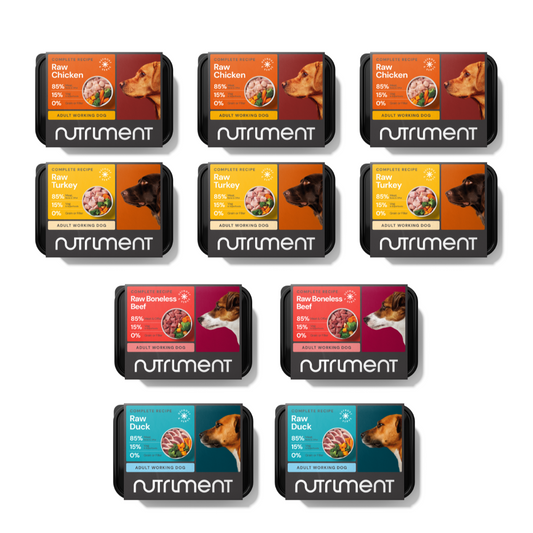 Sale - 15 %Regular price £27.59Regular price£5.52 kg Unit price per
£32.50Sale price £27.59Sale -
 Sale - 10 %Regular price £59.99Regular price£6.00 kg Unit price per
£67.40Sale price £59.99Sale -
 Sale - 4 %Regular price £51.99Regular price£6.50 kg Unit price per
£54.32Sale price £51.99Sale -
 Sale - 8 %Regular price £59.49Regular price£9.30 kg Unit price per
£65.12Sale price £59.49Sale


